Reviewed · GOLDEN GATE BRIDGE TOURS
Learn to Catch and Cook Crab under Golden Gate Bridge SF
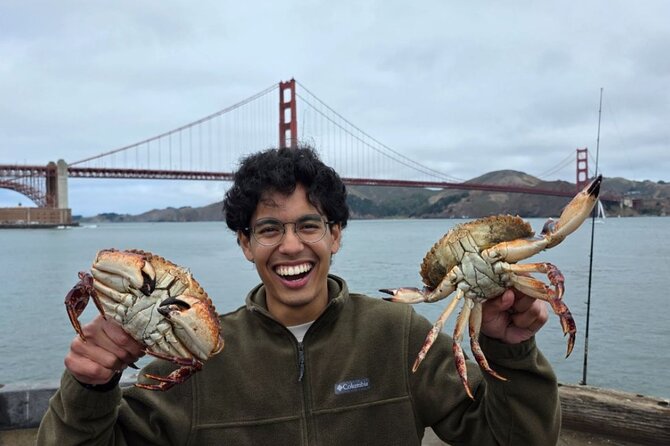
Crab season starts at the pier. This hands-on crabbing experience takes place with Golden Gate Bridge views while you learn to catch Dungeness and Rock crabs and cook them right where you land. It’s part outdoor class, part sea-food meal, and part fun story you’ll tell later.
I really like that the guide work is practical and personal, especially with Lawrence steering the session. You’ll also appreciate that everything is provided, from the gear to the crab snares, so you can focus on learning instead of assembling equipment.
One thing to plan for: it’s an outdoor pier activity with a moderate physical fitness requirement, so you’ll want to be comfortable standing, moving around, and handling your rod and gear.
In This Review
- Key highlights you’ll feel right away
- Golden Gate Bridge crabbing: how the setting shapes the whole trip
- Meet at Torpedo Wharf: what to expect when you arrive
- Casting and catching: using fishing rods plus Durasnare crab snares
- Dungeness and Rock crabs: what you’re really signing up to catch
- From pier to plate: cooking your crab right on-site
- Lawrence and the small-group vibe: how guidance affects your results
- Price and value: why $150 can make sense here
- Who should book this crab lesson under the bridge
- Should you book this Golden Gate Bridge crabbing tour?
- FAQ
- Where is the tour start location?
- How long does the experience take?
- Do I need a fishing license to go crabbing?
- What types of crabs will I catch?
- Is prior crabbing or fishing experience required?
- What if my plans change and I need to cancel?
Key highlights you’ll feel right away
- Golden Gate Bridge backdrop while you learn crabbing
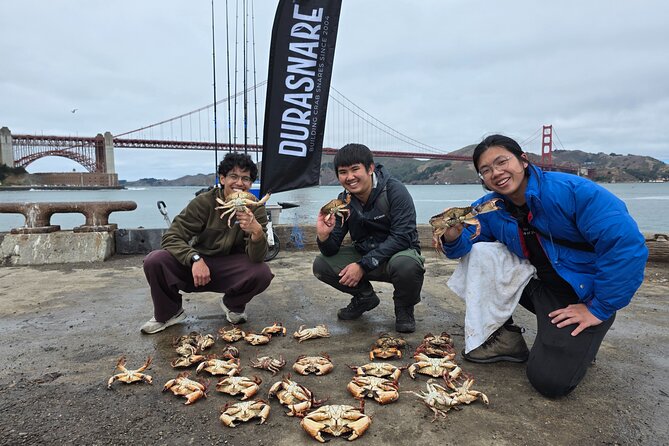
- Catch Dungeness and Rock crabs with provided rods and snares
- On-site cooking, so you eat what you catch
- Small group capped at 8 people
- Lawrence’s teaching style and upbeat guidance
- No fishing license needed
The bridge from every angle, a few more


Golden Gate Bridge crabbing: how the setting shapes the whole trip
The best part is that you’re not just learning crabbing in some generic classroom setting. You’re doing it on a pier in San Francisco, with the Golden Gate Bridge right there as your visual reward. That changes the vibe. The lesson feels like play, and the action feels like it matters.
When I look at this kind of activity, I care about two things: will you actually learn something, and will you end up eating well. This tour hits both. You catch crabs using a fishing rod and specialized crab snares, then you cook your catch on-site so you can enjoy it fresh rather than waiting around for a separate seafood stop.
Do note the pacing: it’s built for hands-on learning within a roughly 3.5-hour window. That’s great for energy. It also means you’ll want to show up ready to listen, then get going quickly.
Meet at Torpedo Wharf: what to expect when you arrive
You start at Torpedo Wharf, Long Ave, San Francisco, CA 94129, and the experience ends back at the same meeting point. In real life, that matters because you don’t have to plan extra rides or figure out where to go after you’re hungry and a little salt-air tired.
This is also a small group setup (up to 8 travelers). Smaller groups usually mean better attention when you’re learning casting or setting snares. You’re not just watching someone else do the work. You’re getting chances to try, get corrected, and improve.
You’ll also appreciate the low friction pre-trip setup: you get a confirmation at booking and a mobile ticket. The operator also says it’s near public transportation, so you may be able to keep your plan simple if you’re not driving.
One more thing: the tour is listed for English. That sounds obvious, but with hands-on learning, clear communication makes a big difference. You’ll also get a guide who’s ready to answer questions as you go, which is exactly what you want when you’re new to crabbing.
Casting and catching: using fishing rods plus Durasnare crab snares
This trip teaches you to catch crabs using a fishing rod and Durasnare crab snares. The key detail here is that you don’t need to bring anything or already know what you’re doing. The guide provides the equipment, and the focus is on learning the process step-by-step.
The experience is built around two phases: learning the basics of how to handle your gear, then putting that knowledge to use to catch crabs. In practice, that means you’ll likely start by getting shown how the setup works, then you’ll practice until it clicks.
Why this matters for you: people often assume crabbing is mostly luck. It can be luck, yes. But the time spent learning technique is what turns a one-time attempt into a repeatable skill. When you can cast and place your snare with more confidence, your odds improve simply because you’re working the system instead of guessing.
Also, since the guide equipment is top-rated and specifically designed for crabbing, you’re using the right tools for the job. That’s a value point. You aren’t paying just for a scenic walk and a brief demo. You’re paying for guided hands-on time with gear that’s meant for this.
From what you’ll see during the session, technique improves over the hours, not instantly. That’s normal. But it’s encouraging. You’re not expected to be a pro on arrival, and you don’t leave feeling like you never got it.
Dungeness and Rock crabs: what you’re really signing up to catch
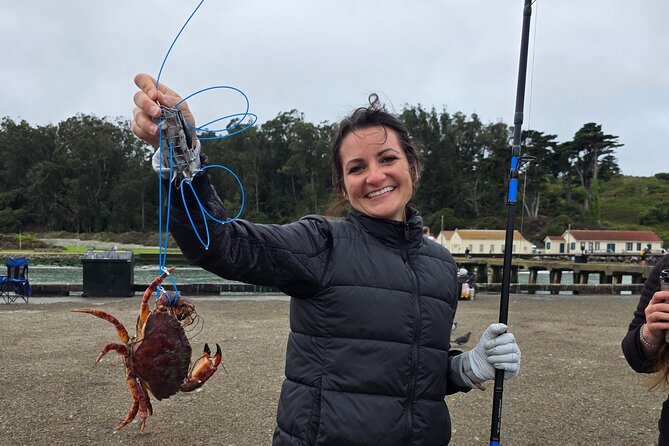
The tour is designed around catching Dungeness and Rock crabs. That’s an important distinction because different crab types can mean different experiences in the moment. Either way, you’re targeting real crabbing, not a pretend “seafood class.”
Here’s what I’d suggest you think about before you go: you’re not just watching the pier life around you. You’re actively fishing and managing your gear on the water’s edge. That’s why the tour notes a moderate physical fitness level. You’ll be working your arms and body for a few hours.
The other big benefit is the no-license piece. The tour says you don’t need a fishing license. That removes a common barrier for first-timers, and it makes this more “book-and-go” than many fishing experiences.
And if you’re going with kids or beginners, the crabbing focus helps. It’s visual and tactile. You’re doing something concrete, not only listening to theory. The goal is to help you catch crabs, then transition to cooking them without skipping the fun parts.
More time on the water, paddle and board

From pier to plate: cooking your crab right on-site
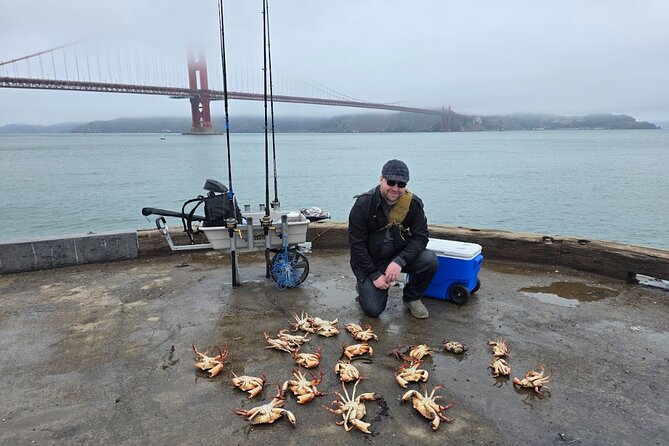
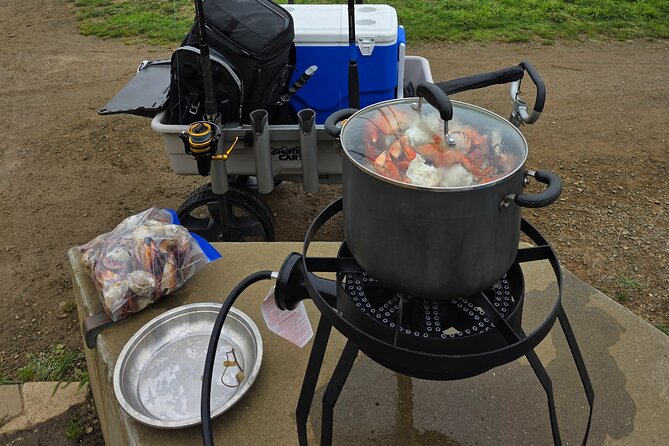
This is the part that makes the experience feel complete. You catch your crabs, then you cook them right on-site so you can eat the freshest seafood possible.
That might sound like a marketing line, but practically, it changes how you enjoy the experience. You’re not standing around hoping you’ll find food later. You go from action to meal without a long gap. You also see the connection between your work and the outcome, which makes the meal more satisfying.
On-site cooking also means the guide can keep the group moving. You’re learning in a controlled setting, and then you get to enjoy the reward immediately. For first-timers, that’s huge. You’re not stuck figuring out how to process a crab yourself afterward.
I like that the experience is framed as learn, catch, cook, eat. It’s a full loop. You won’t just come away with a few photos; you’ll come away with something you can actually taste, and you’ll know it came from your own crabbing.
Lawrence and the small-group vibe: how guidance affects your results
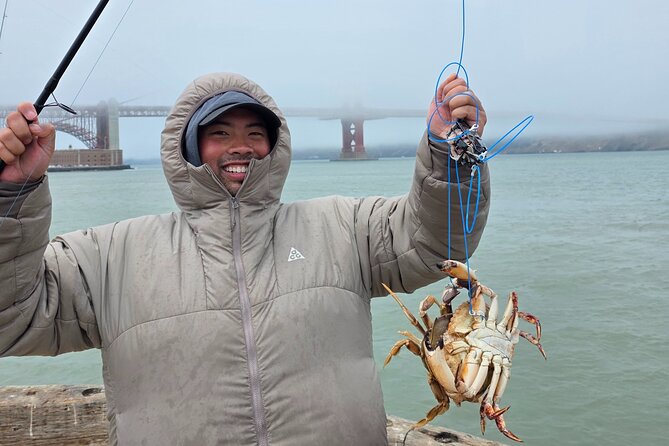
The strongest recurring theme is how well the guide teaches. Lawrence is described as prepared, friendly, and passionate about crabbing. That matters because good instruction is not just facts. It’s encouragement plus correction at the right time.
When you’re new, the hardest part is usually not the equipment. It’s knowing what to do first and what to pay attention to. A guide who explains clearly and answers questions keeps that confusion from turning into frustration. And because the group is capped at 8 travelers, you’re more likely to get direct help when something isn’t working.
One of the most motivating moments in this kind of class is seeing your own progress. The teaching approach here supports that idea: you can improve your casting and technique as the session moves along. That’s why people often leave with a feeling of accomplishment, not just entertainment.
If you’re bringing a family, this is also a comfortable setup. Kids tend to do better when the activity is structured and the guide is actively involved. You’re doing hands-on work, but you’re not left alone with it.
Price and value: why $150 can make sense here
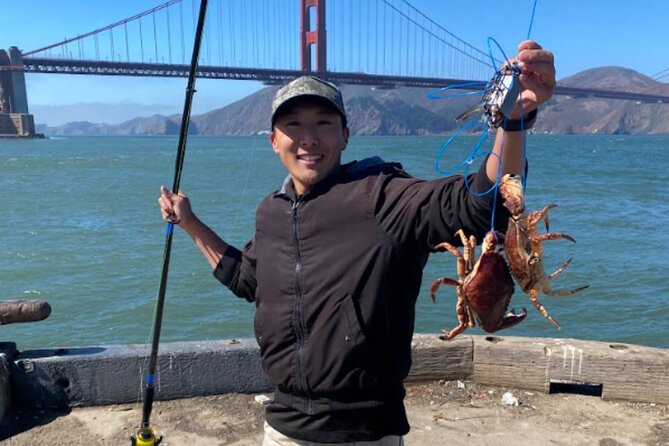
The price is $150.00 per person for about 3 hours 30 minutes. On the surface, that’s not cheap. But value is about what’s included and how much time you actually get doing the core activity.
Here’s what you get that affects the value directly:
- Guided instruction on crabbing, not just a pass-by pier experience
- Equipment provided, including fishing gear and Durasnare crab snares
- You catch Dungeness and Rock crabs as part of the guided lesson
- You cook the crab on-site, then eat what you catch
So you’re paying for a bundled experience: lesson + gear + guided effort + meal outcome. If you’ve ever bought seafood in San Francisco, you know the city can charge for the privilege. I’m not saying this tour automatically beats restaurant prices. But you are paying for participation and instruction, plus the end result.
One more value angle: because it’s a small group and teaching-focused, the cost is less likely to feel like you’re paying for someone else’s labor while you watch. You’re in the action, learning technique and catching crabs during the same window.
Also, the booking lead time averages 12 days. That’s a sign this is something people plan for, not a last-minute gamble. If you want a better chance at a convenient slot, booking earlier is smart.
Who should book this crab lesson under the bridge
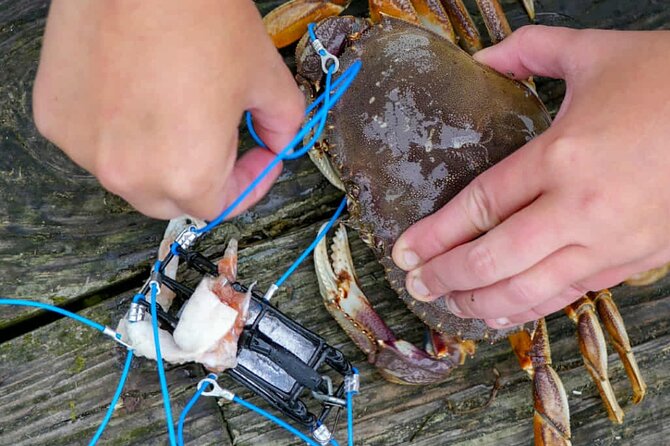
You’ll probably love this if you fit one of these categories:
- You’re new to crabbing and want to skip the guesswork
- You want a hands-on family activity in San Francisco that ends with food
- You like outdoors time but also want structure and coaching
- You enjoy a “learn a skill, then use it” format
The tour also works well for experienced anglers in a different way. Even if you’ve fished before, you’re still learning a specific crabbing method using a rod and snares, then going through the full catch-to-cook flow. That can feel satisfying, because you don’t just catch and leave.
One caution: if you’re sensitive to outdoor conditions, plan accordingly. This is on a pier and outdoors. Dress for wind and cool air, and wear footwear with decent grip. And because it lists moderate physical fitness, don’t assume it’s effortless strolling.
Also, service animals are allowed, and the meeting point is near public transportation. That’s helpful for planning your day around the rest of your itinerary.
Should you book this Golden Gate Bridge crabbing tour?
If your goal is to do something memorable that’s actually active, this is a strong pick. I like that you get a full arc: catch crabs, learn the technique, then cook and eat right on-site. The small group size makes it feel more personal, and the guide’s upbeat, prepared teaching style helps beginners move from awkward to capable during the same session.
I’d only hesitate if you know you’re not comfortable with outdoor pier activity or you can’t manage the moderate physical demands. If that’s you, consider a different type of SF food experience with more controlled walking.
If you can handle standing and learning a hands-on skill, then booking is an easy yes. This is the kind of San Francisco activity that gives you a story, a skill, and a meal from the same two hours of work.
FAQ
Where is the tour start location?
The tour starts at Torpedo Wharf, Long Ave, San Francisco, CA 94129, USA, and it ends back at the same meeting point.
How long does the experience take?
The experience is approximately 3 hours 30 minutes.
Do I need a fishing license to go crabbing?
No. The trip is designed so you don’t need a fishing license.
What types of crabs will I catch?
You’ll learn to catch Dungeness and Rock crabs.
Is prior crabbing or fishing experience required?
No experience is necessary. The tour is set up as a guided lesson and crabbing activity.
What if my plans change and I need to cancel?
You can cancel for free up to 24 hours in advance of the experience for a full refund. If you cancel less than 24 hours before the start time, the amount paid isn’t refunded.
More Tour Reviews in San Francisco
- Muir Woods and Sausalito (Return by Bus or Ferry)★ 4.5 · 5,098 reviews
- Big Bus SF: Hop-on Hop-off Tour with 17 Stops and Sunset Option★ 4.0 · 4,539 reviews
- Napa and Sonoma Wine Country Full-Day Tour from San Francisco★ 4.5 · 4,455 reviews
- Small Group Yosemite and Giant Sequoias Day Trip from San Francisco★ 5.0 · 3,671 reviews
- San Francisco: Golden Gate Bay Cruise★ 4.7 · 3,644 reviews
- San Francisco: Hop-On Hop-Off Sightseeing Tour with 17 Stops★ 4.5 · 3,600 reviews
On the Water: Paddle and Surf
- Beginner Surfing in San Francisco at Pacifica Beach★ 5.0 · 45 reviews
- San Francisco Indoor Skydiving with 2 Flights & Personalized Certificate★ 5.0 · 11 reviews
- Beginner Surf Lessons At Stinson Beach★ 5.0 · 5 reviews
- 2 Hours fun in a Automatic Slingshot★ 5.0 · 4 reviews
- San Francisco Bay Kayak Or Paddle Board Tour★ 4.5 · 4 reviews
- Learn to Paddle Board on the San Francisco Bay!★ 5.0 · 4 reviews
The Golden Gate, End to End
- Golden Gate Bridge Muir Woods Sausalito with Optional Alcatraz★ 5.0 · 1,106 reviews
- San Francisco Golden Gate To Sausalito Bike Tour★ 4.5 · 751 reviews
- Golden Gate Bridge Guided Bicycle or E-Bike Tour from San Francisco to Sausalito★ 5.0 · 679 reviews
- San Francisco Golden Gate Bridge Bike or Electric Bike Rental★ 4.5 · 564 reviews
- San Francisco: Golden Gate Bridge to Sausalito Cycling Tour★ 4.7 · 541 reviews
- San Francisco: Golden Gate Bridge Catamaran Cruise★ 4.9 · 499 reviews
Just Reviewed: Fresh San Francisco Tours
- Private San Francisco City Tour + Alcatraz (Tickets Incl., Max 6)
★ 5.0 · 3 reviews - San Francisco: North Beach Food and History Walking Tour
★ 5.0 · 3 reviews - San Francisco Bay Cruise and City Combo Tour
★ 3.5 · 3 reviews - San Francisco City Half-Day Private Custom Tour
★ 5.0 · 3 reviews - San Francisco: Muir Woods, Point Reyes, and Meadery Tour
★ 4.2 · 3 reviews - Private Muir Woods and Sausalito Half Day Tour
★ 5.0 · 3 reviews
Golden Gate Bridge Tours, compared.
 ★ 5.0Golden Gate Bridge Muir Woods Sausalito with Optional AlcatrazFrom $1191,106 reviews
 ★ 4.5San Francisco Golden Gate To Sausalito Bike TourFrom $75751 reviews
 ★ 5.0Golden Gate Bridge Guided Bicycle or E-Bike Tour from San Francisco to SausalitoFrom $90679 reviews
 ★ 4.5San Francisco Golden Gate Bridge Bike or Electric Bike RentalFrom $20564 reviews
 ★ 4.7Golden Gate Bridge to Sausalito Cycling TourFrom $72541 reviews
 ★ 4.9Golden Gate Bridge Catamaran CruiseFrom $65499 reviews
 ★ 4.5Golden Gate Bridge and Lombard GoCar TourFrom $169355 reviews
 ★ 4.6Golden Gate Bridge Bike RentalFrom $16307 reviews
Browse the lists this tour appears in